Wednesday, August 26, 2026 | Time: 8:30am – 12:30pm | Price: $35
If you are interested in attending this tour, sign up is available during registration. There is limited capacity.
Hosted by: Rice University
Find out more about the labs below:
Nanoscale Heat Transfer Lab
Visit the website
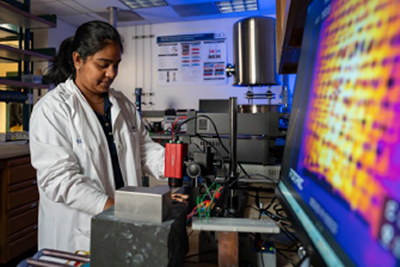
PI: Geoff Wehmeyer
Lab Description: The Rice Nanoscale Heat Transfer Lab develops switchable thermal devices and explores nanostructured thermal materials to enable improved thermal management in aerospace, semiconductor, and energy applications. We have explored new approaches using temperature-dependent magnetic forces to switch, rectify, and even amplify heat flows in centimeter-scale thermal switch, diode, and transistor devices, providing new capabilities for passive thermal management of spacecraft, batteries, and buildings. We also use electrothermal measurements and phonon ray tracing simulations to optimize thermal transport in nanostructured materials, including carbon nanotube fibers of interest for advanced electrical and thermal applications. By exploring new mechanisms that lead to switchable and nonlinear heat transfer and by elucidating the underlying thermal transport mechanisms in nanostructured materials, we aim to improve the energy efficiency and thermal management capabilities of next-generation technologies.
Cognitive Human-Robot Partnership Lab
Visit the website
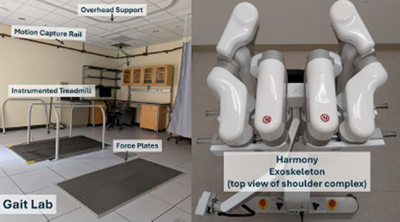
PI: Keya Ghonasgi
Lab Description: The Cognitive Human-Robot Partnership (CHRP) Lab, led by Dr. Keya Ghonasgi, develops wearable sensing and robotic actuation to quantify and rehabilitate human motion. The lab focuses on motor impairments caused by neurological injuries, such as Stroke, Cerebral Palsy, and Parkinson’s. We also explore the parallels and differences between upper- and lower-limb applications in rehabilitation and assistance. Our lab resources include a gait lab with 3D motion capture and force sensing capabilities, the Harmony upper-limb exoskeleton, an IMU-based sensing platform, and virtual reality platforms for studying serious games. The lab's overarching goal is the intelligent engineering of personalized, adaptive wearable systems that transition well from research settings to the real world, learning from and evolving with each user’s unique motion needs.
Preston Innovation Laboratory (PI Lab)
Visit the website
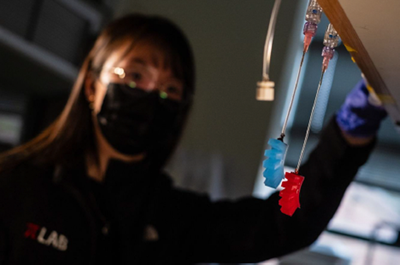
PI: Daniel Preston
Lab Description: We advance the science and engineering of systems at the intersection of energy, materials, and fluids, with a focus on uncovering and exploiting new fundamental physics and mechanisms. In the energy space, we design technologies for efficient power generation, waste heat recovery, and advanced thermal management of high-performance electronics. For materials, we create and repurpose functional designs, particularly in soft and architected systems, to enable new capabilities in robotics, interfacial phenomena, and responsive material behavior. Related to fluids, we study and control how liquids interact with structured surfaces, from repellency to wicking and active manipulation, often drawing inspiration from natural systems.
TexLab
Visit the website
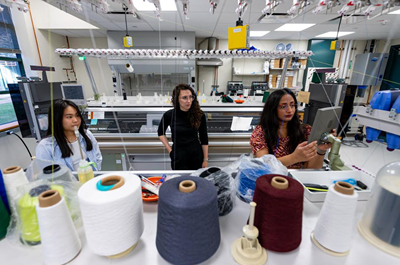
PI: Vanessa Sanchez
Lab Description: Texlab focuses on the intersection of materials, manufacturing, and robotics, with an emphasis on textile-based systems. The lab develops stimuli-responsive and shape-changing polymeric materials and integrates them into advanced manufacturing workflows to create functional structures. Through material-in-the-loop design and automated experimental processes, Texlab explores how structure and fabrication can be leveraged to program mechanical and robotic behavior in soft systems. Current efforts include textile-based sensors, actuators, and wearable robotic devices, with applications spanning human-interfacing technologies and extreme environments.