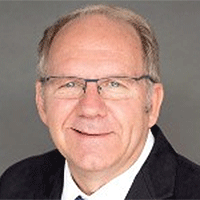
David Daggett
University of Connecticut
Presenting in Track 6: Advances in Aerospace Technology
Thursday, November 12th, 8:00am - 8:45am
Presentation Title: Addressing Global Aerospace Challenges Through Innovative Ideas
Abstract: This educational presentation explores several aerospace design challenges and presents some innovative design ideas for next-generation aerospace vehicles that maximize energy efficiency, environmental performance, and long-term viability. Drawing on lessons from aerospace history, emerging airframe/propulsion technologies and study results from a recent ARPA-E contract, the work emphasizes possible solutions across airplane wings, engines, fuels, fuselage architecture, and aerospace operational concepts. Results included high-aspect-ratio truss-braced wings, folding wing mechanisms for airport compatibility, and propulsion placement that preserves uniform inlet airflow and minimizes aerodynamic disturbance. Airplane propulsive efficiency is advanced through ultra-high-bypass engines, open-fan concepts, and hybrid-electric architectures incorporating Solid Oxide Fuel Cells (SOFCs) with supporting turbomachinery for takeoff and high-altitude performance. Fuel selection is addressed through a safety, operability and sustainability lens, highlighting (Renewable) Liquefied Natural Gas as a practical near-term option relative to ammonia or hydrogen. The presentation also examines non-CO2 climate impacts such as persistent contrails. Beyond technical performance, the significance of this study underscores commercialization enablers such as possible modular fuselage designs, multi-role civil/military adaptability, passenger-centered cabin layouts, and upgrade-ready architectures that account for aircraft designs exceeding 50 years of production. Collectively, these considerations define future aerospace concepts that could be efficient, scalable, lower-risk, and better aligned with evolving market and environmental demands.
Biography: David L. Daggett, Ph.D., is a retired Boeing Technical Fellow and Professor of Practice at University of Connecticut with more than 50 years of aerospace experience. His career has centered on advancing sustainable aviation through pioneering work in Sustainable Aviation Fuel (SAF), fuel cells, and next-generation aircraft and propulsion systems. He co-invented one of the first fuel cell–powered demonstrator aircraft, launched early SAF flight initiatives, pioneered the Solid Oxide Fuel Cell Auxiliary Power Unit concept, and led Boeing’s Advanced Concepts "Green Team". An AIAA Associate Fellow, he continues to lead university and ARPA-E research into low-emission aircraft technologies.