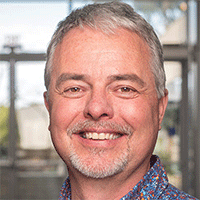
James Friend
Washington University in St. Louis
Presenting in Track 1: Acoustics, Vibration, and Phononics
Tuesday, November 10th, 8:00am - 8:45am
Presentation Title: Controlling the Uncontrollable: Acoustic Manipulation of Turbulent and Porous-Media Flows from Fundamental Physics to Functional Devices
Abstract: Acoustic waves provide a remarkable pathway to manipulate fluids across scales ranging from nanometers to centimeters, enabling phenomena that span directed transport in porous materials to strongly nonlinear turbulent wave dynamics. In this talk, I will discuss recent advances from our laboratory in understanding and exploiting acoustically driven flows in systems that are traditionally considered difficult to control: turbulent free-surface flows and fluid transport through porous media.
First, I will present recent results on capillary-wave turbulence generated by high-frequency ultrasonic excitation of sessile droplets. Using high-speed digital holographic microscopy with nanometer-scale vertical resolution and frame rates exceeding 100,000 frames per second, we observe transitions from weak and discrete turbulence to strongly nonlinear turbulent states and atomization. Of particular interest are intermittent transitions between neighboring turbulent regimes modulated by viscosity and excitation strength, revealing stochastic switching behavior and nonlinear resonance broadening not captured by classical weak-wave turbulence theory. These tabletop turbulent systems provide an experimentally accessible platform for studying rogue-wave statistics, intermittency, and machine-learning-assisted prediction of nonlinear flow behavior. This work forms part of our DARPA STORMLAP effort aimed at developing scientific machine learning approaches for strongly nonlinear turbulent systems.
Second, I will discuss the development of floating-electrode unidirectional transducers (FEUDTs) for acoustically driven transport through porous media. We demonstrate that unidirectional surface acoustic wave generation can transform porous materials into actively pumped transport platforms, overcoming limitations associated with tortuous pore networks, viscous dissipation, and counterflow. We identify a practical design rule in which transport is maximized when the acoustic wavelength approaches the characteristic pore dimension. Under optimized conditions, these systems sustain directional flow velocities hundreds of times greater than diffusion alone while operating at sub-watt power levels. The results establish new opportunities for acoustic control in filtration, diagnostics, energy systems, and biomaterials.
Together, these studies suggest that acoustically driven flows offer not merely new microfluidic tools, but experimentally controllable model systems for probing and engineering nonlinear transport phenomena across physics, materials science, and bioengineering. Acoustic waves provide a remarkable pathway to manipulate fluids across scales ranging from nanometers to centimeters, enabling phenomena that span directed transport in porous materials to strongly nonlinear turbulent wave dynamics. In this talk, I will discuss recent advances from our laboratory in understanding and exploiting acoustically driven flows in systems that are traditionally considered difficult to control: turbulent free-surface flows and fluid transport through porous media.
First, I will present recent results on capillary-wave turbulence generated by high-frequency ultrasonic excitation of sessile droplets. Using high-speed digital holographic microscopy with nanometer-scale vertical resolution and frame rates exceeding 100,000 frames per second, we observe transitions from weak and discrete turbulence to strongly nonlinear turbulent states and atomization. Of particular interest are intermittent transitions between neighboring turbulent regimes modulated by viscosity and excitation strength, revealing stochastic switching behavior and nonlinear resonance broadening not captured by classical weak-wave turbulence theory. These tabletop turbulent systems provide an experimentally accessible platform for studying rogue-wave statistics, intermittency, and machine-learning-assisted prediction of nonlinear flow behavior. This work forms part of our DARPA STORMLAP effort aimed at developing scientific machine learning approaches for strongly nonlinear turbulent systems.
Second, I will discuss the development of floating-electrode unidirectional transducers (FEUDTs) for acoustically driven transport through porous media. We demonstrate that unidirectional surface acoustic wave generation can transform porous materials into actively pumped transport platforms, overcoming limitations associated with tortuous pore networks, viscous dissipation, and counterflow. We identify a practical design rule in which transport is maximized when the acoustic wavelength approaches the characteristic pore dimension. Under optimized conditions, these systems sustain directional flow velocities hundreds of times greater than diffusion alone while operating at sub-watt power levels. The results establish new opportunities for acoustic control in filtration, diagnostics, energy systems, and biomaterials.
Together, these studies suggest that acoustically driven flows offer not merely new microfluidic tools, but experimentally controllable model systems for probing and engineering nonlinear transport phenomena across physics, materials science, and bioengineering.
Biography: James Friend is the Stephen F. and Camilla T. Brauer Distinguished Professor and Chair of Mechanical Engineering and Materials Science at Washington University in St. Louis. His research focuses on acoustofluidics, nonlinear fluid dynamics, biomedical ultrasonics, and microscale transport phenomena, particularly the use of acoustic waves to manipulate fluids, interfaces, particles, and biological systems.
Before joining Washington University, he served on the faculty at the University of California San Diego following 14 years as a faculty member in Japan and Australia. He has published more than 350 peer-reviewed papers, holds 32 patents, and has led over $37 million in externally funded research programs spanning acoustofluidics, sonogenetics, microfluidics, turbulence, and biomedical device development. His recent work explores strongly nonlinear capillary-wave turbulence, acoustically driven transport in porous media, and ultrasound-enabled biomedical technologies.
Professor Friend is a Fellow of the IEEE and the Royal Society of Chemistry. Among other honors, he received the IEEE Carl Hellmuth Hertz Ultrasonics Award and the UC San Diego Distinguished Teaching Award. He also serves as cofounder and CTO of multiple technology startups focused on medical diagnostics, neurovascular intervention, and energy systems.