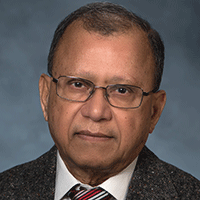
Khairul Zaman
NASA Glenn Research Center
Presenting in Track 11: Fluids Engineering
Wednesday, November 11th, 8:00am - 8:45am
Presentation Title: Turbulence We Cannot See: Measurement Limits in High-speed Boundary Layers
Abstract: Measurements form the foundation of turbulence research, yet the instruments used to obtain them inevitably impose constraints. In high-speed wall-bounded flows, these effects may be more consequential than generally recognized. Hot-wire measurements in fully turbulent exit boundary layers of nozzle flows often report turbulence intensities that appear unusually low. Such observations could be interpreted as evidence of compressibility effects, probe response limitations, or flow acceleration within the nozzle. However, a closer examination points to a different explanation: spatial averaging associated with the finite length of hot-wire probes. Analysis of experimental data, together with insights from low-speed boundary-layer studies reported in the literature, indicates that this spatial averaging leads to a reduction in the measured turbulence intensities. To further examine this effect, Large Eddy Simulation (LES) is used to examine the influence of probe dimensions on the recorded statistics. The results show that small-scale turbulence near the wall is averaged over the length of the probe, leading to systematic underestimation of turbulence levels.
While the phenomenon is studied for nozzle exit flows, the implications extend well beyond a single configuration. Similar measurement limitations are likely present across a wide range of propulsion components and compressible boundary-layer flows at all Mach numbers, where accurately resolving near-wall turbulence remains a challenge for currently available measurement techniques. Addressing this challenge will require new measurement approaches that will reduce the probe dimensions from millimeters to microns.
Biography: Dr. Khairul Zaman is currently an Aerospace Engineer in the Aeropropulsion Division of NASA Glenn Research Center. He joined NASA in 1982, initially working at the Langley Research Center and moving to GRC in 1985.
Dr. Zaman received his PhD degree in Mechanical Engineering from the University of Houston in 1978. His PhD and postdoctoral work, under the mentorship of Professor Fazle Hussain, led to a series of publications addressing the dynamics of coherent structures in shear layers and jets. At NASA Dr. Zaman continued and extended these studies to higher Mach number shear flows, particularly with respect to jet noise mechanisms and control. These studies played a pivotal role leading to chevron technology employed in modern jet engines, a technique for suppression of howl in ground test facilities, in addition to addressing such fundamental phenomena as transonic tones and excess broadband noise in overexpanded jets, guided jet waves and their impact on jet noise, and the effect of initial boundary layer state on jet noise and plume development. Over the years, he served as a member of many committees at GRC as well as various NASA-wide committees on turbulence research. He has been the mentor of several undergraduate interns, five graduate students, four post-doctoral fellows, and served as NASA colleague of four summer faculty fellows, many returning for multiple years. He has monitored about twelve University grants. He is a Fellow of ASME (American Society of Mechanical Engineers), Fellow of APS (American Physical Society) and Associate Fellow of AIAA (American Institute of Aeronautics and Astronautics).