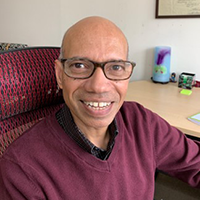
Taher Saif
University of Illinois at Urbana-Champaign
Presenting in Track 14: Micro- and Nano-Systems Engineering and Packaging
Tuesday, November 10th, 8:00am - 8:45am
Presentation Title: MEMS Sensors: Probing Nanomaterials to Living Neurons
Abstract: Microelectromechanical systems (MEMS) have revolutionized a wide range of technologies since the 1990s, including automotive airbags, digital light displays, and navigational guidance systems. Their success stems from their small size, batch fabrication, and seamless integration with electronics. This revolutionary approach to making small devices has also paved the way for miniature sensors and instruments capable of conducting fundamental scientific studies at low cost and with exceptionally high resolution, thereby helping democratize access to advanced experimental capabilities.
Here, we will discuss one such MEMS-based sensor. The device consists of a force-sensing spring and an anchor, with the sample positioned between them. The sample can be integrated directly with the sensor during fabrication, as in the case of nanoscale thin films, or it can self-assemble with the sensor, as occurs with soft biological materials containing living cells. Such integration and self-assembly eliminate the challenges associated with handling, positioning, and aligning extremely small or delicate samples with a force sensor.
The sensor's small size provides another important advantage: it enables direct in situ observation of the sample inside advanced analytical instruments, including high-resolution optical and electron microscopes. Mechanical measurements can therefore be correlated directly with structural changes in the sample, providing new opportunities to uncover the fundamental mechanisms governing material deformation and cellular behavior.
We have applied this sensor platform to two distinctly different classes of materials. The first involves nanograined metallic thin films subjected to uniaxial tension. These experiments revealed the surprising observation that plastic deformation in nanograined metals can be reversible with time, providing new insight into deformation mechanisms at the nanoscale.
The second application involves living neurons embedded within an extracellular matrix. Studies of hippocampal neurons derived from mouse brain show that, as neurons establish connections with one another, they become contractile and generate a mechanically tensed neuronal network. This tension is not simply a consequence of network formation; it appears to be essential for neuronal function and for the transmission of information between neurons. These findings suggest that the long-standing electrochemical view of brain function should be expanded to include mechanical tension as a third fundamental component, alongside biochemical signaling and electrical activity. Recognizing this mechanical dimension of neuronal function may provide a new framework for understanding the brain and could ultimately open new avenues for investigating and treating neurological disorders, including dementia and Alzheimer's disease.
Biography: Professor Saif was born in Dhaka, Bangladesh. He earned BS and MS degrees in Civil Engineering from Bangladesh University of Engineering and Technology and Washington State University, followed by a PhD in Theoretical and Applied Mechanics at Cornell University. He conducted postdoctoral research on MEMS at Cornell Electrical Engineering before joining the Department of Mechanical Science and Engineering at the University of Illinois Urbana-Champaign (UIUC) in 1997. His interdisciplinary work spans mechanics of neurons and cardiac cells, tumor microenvironments, biohybrid robotics, and nanomaterials. Professor Saif is a Fellow of the American Society of Mechanical Engineers (ASME) and the American Association for the Advancement of Science (AAAS). He received the 2018 Koiter Medal from American Society of Mechanical Engineers, and the 2020 Engineering Science Medal from the Society of Engineering Science. In 2024, he was elected to the National Academy of Engineering of USA. He was endowed with Grainger Distinguished Chair in 2025 in the Grainger College of Engineering, UIUC.